We’ve seen firsthand that, when it comes to mold detection, not all methods are created equal.
If you’re just starting to suspect mold or struggling to get clear answers, we’re writing this post to validate that it can be very confusing to know which method to use, when, and why.
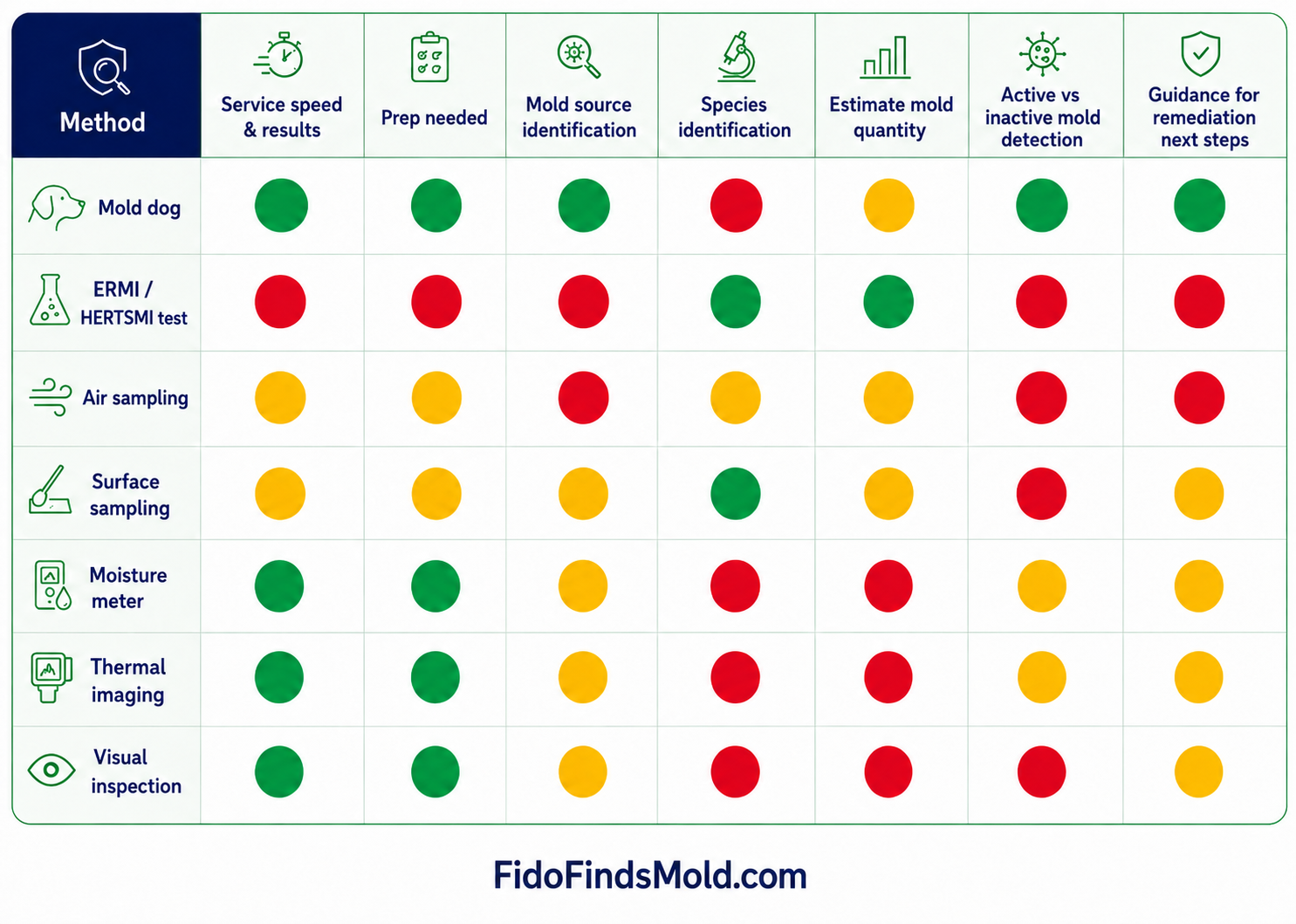
So let’s break it down. Below is a look at how the most common mold detection methods stack up in terms of speed, prep, source identification, species identification, and whether they actually help you figure out what to do next.
Quick answer: which mold test is best?
There isn’t one “best” mold test. The right method depends on what you’re trying to learn:
If you want to know what species are present → ERMI / HERTSMI
If you want to know whether moisture is currently active → Moisture meter + thermal imaging
If you want to know where mold is actually growing → Source-focused inspection and mold detection dogs
But there’s more to it than that, and we’ll dive into it all below.
A visual guide to mold testing methods
Why air & surface testing can miss mold problems
One of the most common assumptions is that air testing is the gold standard. In reality, it’s just one tool. And in our experience, it’s a very temperamental one.
Air and surface sampling capture a single moment in time. Results shift based on airflow, HVAC cycles, humidity, outdoor spore counts, and recent activity in the space.
Years ago, when we were renting, our dryer broke, and the laundry area became so humid that the wallpaper started peeling back. We discovered black mold crawling behind it. We were horrified.
Even though we could see it with our own eyes, we paid for a reputable mold company to come out and collect air samples. Air sampling was the only type of mold test we knew about at the time, and we wanted to have documentation to share with our landlord.
We were stunned when the results came back “normal.” That experience changed how we think about testing.
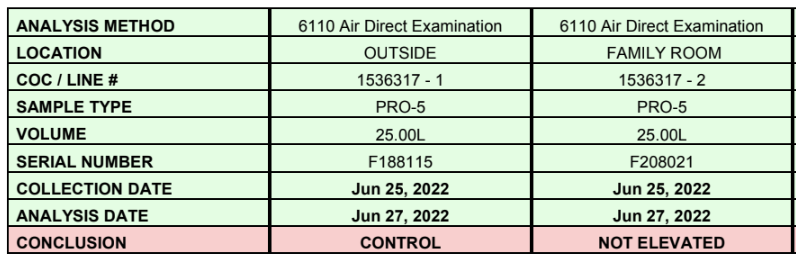
Our air sampling results were “normal”… even though we could see black mold crawling up our walls.
What we know now is that mold spores aren’t constantly airborne. If air is still, humidity has dropped, or spores have settled onto surfaces, air sampling can completely miss an active problem. Because of how variable it is, we don’t recommend relying on air samples to confirm or rule out a mold issue.
Active vs inactive mold: why it matters
Mold doesn’t need to be wet today to be a problem.
Once materials have supported growth, mold can remain even after the moisture source is fixed. When conditions dry out, mold often releases more spores, which can increase airborne exposure.
Where we usually suggest starting
If you suspect mold, we almost always recommend starting with the basics:
A thorough visual inspection
A moisture meter
Thermal imaging
Mold needs moisture to grow. If you can identify where water intrusion or elevated moisture is happening, then you’re probably much closer to the root cause than a lab report alone can get you.
That said, moisture meters and thermal imaging tools work best when there is a current moisture issue.
If the source of the problem (e.g., a leaky pipe) has already been fixed but the mold was never properly remediated, moisture meters and thermal imaging may not pick up anything unusual. But no moisture doesn’t necessarily mean there’s no mold.
So while we do think moisture-detecting tools can be super helpful, they don’t always paint a full picture.
(This is also why, in our inspections, we don’t rely on just one method. Before we deploy our mold dog, we do a detailed visual inspection—indoors and outdoors—and a thermal imaging scan to look for hidden moisture patterns.)
We have to give a shoutout to Brooke Geahan, founder of The Heal Hive, who taught us a lot about these testing methods. She has so much knowledge about mold—where it hides, how to detect it properly, and the ways it can impact the body.
When you need to pinpoint the exact source
This is where mold detection dogs were a game changer to us and so many others.
Certified, expertly trained mold detection dogs can sniff out mold at the source, even if the area is dry and no longer showing visible signs of moisture. That might be behind walls, under flooring, inside cabinetry, or other hard-to-reach areas. Without tearing down walls!
They’re focused on one question: Where is it growing right now? That’s very different from asking, “Are there spores in the air right now?” These dogs are trained to locate mold sources and not just what happens to be floating around at a given moment.
Where lab testing fits in
That doesn’t mean lab testing has no place in the process of figuring out what’s going on in your space.
ERMI and HERTSMI testing can be really helpful if you’re trying to understand overall mold burden or identify specific species. They provide data. What they don’t do well is narrow down where the mold is actually growing.
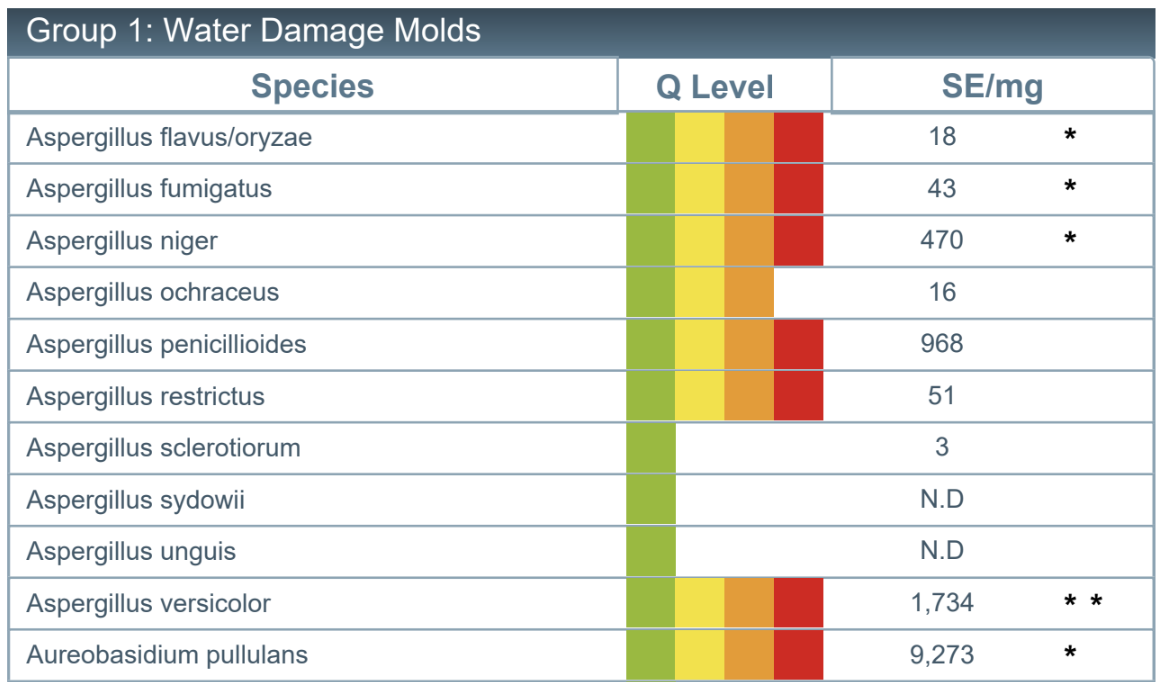
One of our own ERMI test results. This snapshot only shows about a quarter of the results.
We’ve used this lab for years for our own home environment testing. (No affiliation.)
Keep in mind that ERMI and HERTSMI testing require collecting enough settled dust for a sample. From a practical perspective, this can be annoying—especially if you (like us) try to keep a clean space. Sometimes you have to really search for enough dust, or allow more time to pass, to gather a proper sample.
When we were in the market to buy a house, we collected dust samples for ERMI testing in every home we seriously considered. We wanted to understand potential mold exposure before making an offer. But while ERMIs can help identify overall mold burden and species, it’s hard to know exactly what you’re sampling. Is it dust from this week? Three years ago? From before a past water event?
So while these tests can be valuable, they don’t typically answer the very practical question many people are asking: Where is the mold coming from?
That’s where source-focused methods (trained mold-detection dogs, thermal imaging, and thorough inspection) tend to provide more actionable next steps.
When to use each mold testing method
OK, so the golden question: Which mold test is best? We wouldn’t say there is just one, exactly. There’s just the right tool for the question you’re trying to answer.
ERMI / HERTSMI makes sense when:
You want species-level data
You’re evaluating overall burden
You’re house hunting
Moisture meters & thermal imaging make sense when:
There’s an active leak
You suspect hidden moisture
You’re trying to prevent growth
Mold detection dogs make sense when:
You need to locate a hidden source
You want to know if a space has the “all clear”
The area is dry, but symptoms persist
You want non-invasive confirmation before opening walls
Air testing makes sense when:
You need documentation (and are prepared for false negative results)
You’re comparing indoor vs outdoor spore counts
You understand it’s just a snapshot
How much does mold testing cost?
Air testing: $300–$800
Costs vary depending on region, scope, and whether multiple samples are collected.
ERMI testing: $250–$400 (lab only)
Like air testing, costs vary by region, scope, and number of samples.
Professional inspections: $300–$1,000+
Mold detection dog inspections: varies by region and scope
There are lots of professionals out there who can come assess your space. But before or alongside hiring someone, it helps to understand what each method can actually tell you and what it can’t.
Starting to piece the picture together yourself with tools like moisture meters, humidity monitors, or thermal imaging can be an empowering first step. You don’t have to become an expert. Just understanding how moisture behaves in a space can shift everything. (It definitely did for us!)
Educating yourself is how you start to take back control and move closer to getting real answers to your mold questions.